Showing posts with label social software. Show all posts

Saturday, August 05, 2006

Beyond Software


You can chart the rise of the modern packaged software industry to an open letter that William 'Bill' Gates sent to the Homebrew Computer Club in February 1976 complaining about software piracy.

The club was built on a counter-culture ethic of sharing information , knowledge and code. Just as the packaged software industry rose with Microsoft, so the homebrew movement morphed into what we now know to be open source software.

Tim O'Reilly has deliberately stirred controversy with a posting about
open source software licences are obsolete, however the more serious point that he makes about how the legal aspects that facilitate open source software need to be adapted to fit the new service orientated web (web 2.0 if you will).

Up till now most organisations such as flickr, Yahoo! and Google have been open about their key service IP: their APIs, however what happens if you get a management team with someone like Darl McBride from The SCO Group put in place.

How is a mash-up owned: is it the person who does the mash-up, the people whose content is used in the mash-up or the services that the mash-up has been derived like flickr XML feeds for instance. Web 2.0 is a lawyers wet dream and O'Reilly's argument is that the situation needs to be fixed BEFORE it breaks.

Tuesday, August 01, 2006

Links galore


Stopgap Marketing and Mad.co.uk have published the results of their salary and work survey across all aspects of marketing. Women made up about two thirds of the respondents and the best sector to work in from a pay perspective is market research.

The biggest areas of dissatisfaction (page 36) were strong leadership from senior management and the lack of a clear career path. So it seems whilst the board thinks that marketing is too important to be left to marketers, marketers think that the directors should make a start by running the company. Full details here as a PDF document. Want to know more, contact Lou Bushell at Stopgap.

The nice people over at Terratag have launched their latest t-shirt designs, buy one now and pretend that you are down with the kids and can talk their hepcat-speak daddio.

Also Orange have finally released details of their project. It's an advertisement supported by a Big Brotheresque blog: the blog has the best argument against convergence I have ever heard, a quote from a participant called Jeff "I have deleted all the crap that came on the phone to free up memory and have copied as many of my Bonnie Tyler tracks on to it as it will hold."

There goes Orange's ARPU targets up in smoke then. The Orange ad will appear tonight on ITV, but I am sure they will have people like Iain Tait and the super-sharp coders at Poke London seeding it on YouTube in no time at all.

Mog is the new Last.fm seriously. Check it out.

Lastly thanks to a review of Why Johnny Can't Brand DSI (dominant sales idea) is the new USP (unique sales proposition), just another example of why Bill Hicks told marketing and advertising people to kill themselves: "By the way, if anyone here is in advertising or marketing, kill yourself. No, this is not a joke: kill yourself . . . I know what the marketing people are thinking now too: 'Oh. He's going for that anti-marketing dollar. That's a good market.' Oh man, I am not doing that, you fucking evil scumbags."

Jargon Watch


Jason Calacanis over on his blog tries to create a new meme to encourage usage of the new Netscape website.

Diggscape - The action of submitting a story to both DIGG and Netscape, or asking users to vote for your story on the two services.

There is still the opportunity to get this on to UrbanDictionary as well, as it is currently undefined.

It's interesting the way Jason has tried to get Netscape direct injected into the online Zeitgeist and is something that PRs can learn from.

It will be interesting to see how successful Netscape becomes in its new reincarnation. What is also very interesting is the way that Jason has removed other services like del.icio.us, reddit and Yahoo! MyWeb and pared it down just him and Digg.

Thus setting up a classic David and Goliath-type story, with Netscape being David.

One of the biggest problems that I had as a PR person when I worked inhouse at Yahoo! was that the dominant (maybe monopolistic position?) of Google meant that the name of the search engine became a verb to describe the act of searching online itself. Despite my best efforts I even found myself slipping into it a few times.

Now that the profit imperative has been removed I google with abandon.

Saturday, June 24, 2006

Technology brands


I used to think that technology and brand marketing were two separate disciplines, at least the way that I had seen them practiced in the past.

So I found the
Forrester Research report The 2005 Technology Brand Scorecard of interest. Forrester has run this benchmarking survey for a number of years and compared to 2003 most device manufacturers saw their trust level fall. Only two brand rose: Apple and TiVo.

Apple however hasn't had it all its own way, iPod users tended not to recognise themselves as Apple Computer users, so Apple would be wise to emphasis the tie between the two devices. Apple also needs to reach out to less affluent families and persuade them that purchasing an Apple is good value. (This shouldn't be too hard with devices like the Mac Mini and MacBook).


Forrester Research measured their scorecard on three parameters:


1. Brand trust. We ask consumers to indicate how much they trust each brand on a scale of 1 to 5, where 1 means "distrust a lot" and 5 means "trust a lot." All brands are trusted by their users more than they are distrusted, scoring well over the midpoint of 3: Scores for PC and CE manufacturers range from a low of 3.9 for Microsoft to a high of 4.6 for Bose. To calculate a brand trust score, we also factor in the change in brand trust since 2003.

2. Brand potential. The number of households that plan to use a brand — but aren't regular users today — are a brand's aspiring or potential users. This untapped market includes new customers, consumers who don't use the brand at all today, and casual customers, consumers who don't consider themselves regular users today. Aspiring users range from a low of 3.2 million households for Microsoft to a high of 17.5 million households for Bose. To calculate a brand potential score, we also deduct the "at-risk" customers, consumers who give the brand a trust score of 1 or 2 and are at risk of defection.

3. Brand adoption. Forrester asks whether a household uses a brand "regularly," yielding adoption levels that range from a high of 50.8 million households for Microsoft to a low of 3.8 million households for TiVo. To calculate a brand adoption score, we also factor in the change in the number of regular users between 2003 and 2005.

Sunday, June 11, 2006

Getting ready for lift-off?


Yahoo! Answers was one of the last projects that I worked on when I was inhouse, I will hold my hand up and admit that I was a hawk in terms of the product being a 'killer application' mainly because it failed my own 'test' of how is this relevant to my online life?

The prototypes that I saw internally reminded me of the self service customer solutions offered by the likes of RightNow Technologies and Transversal and the support forums provided by Apple for users.
In some ways I was wrong (and I am happy to be wrong in this case).

Windows Live QnA doesn't seem to have gone anywhere, Lycos IQ: though superior in terms of design and features doesn't seem to have got that much traction so far.

According to Hitwise (via SearchEngineWatch), Yahoo! Answers is now the third most popular reference site online, however its 2.94 per cent market share is puny in comparision to the 16.76 per cent marketshare of Wikipedia which has a Googlesque sector dominance.


Steve Rubel has talked about Yahoo! Answers on his MicroPersuasion blog Marketers will Answer to Yahoo! and sees the opportunity for sponsored sections, which kind of squares the circle in the way that I viewed the product.

It offers yet another opportunity for direct interaction with consumers and a channel for cummunications, but not a full-on dialogue.


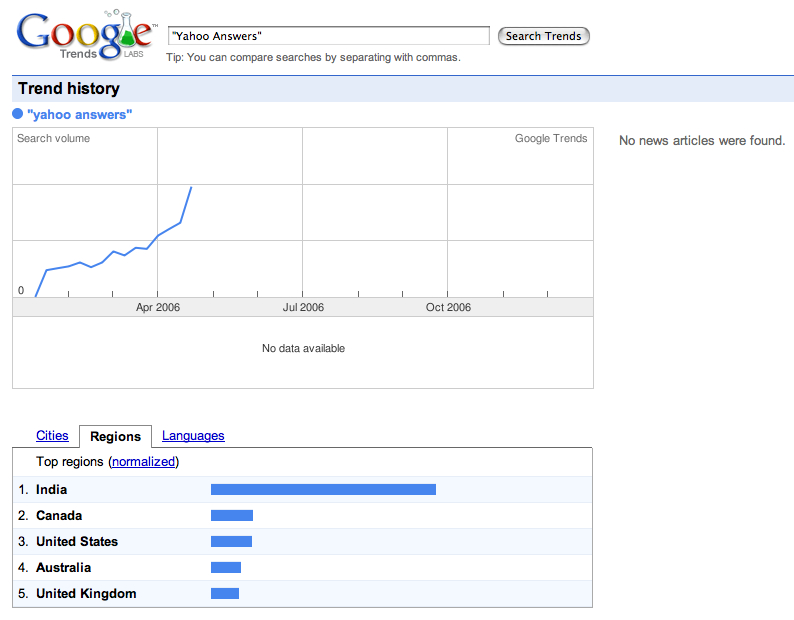
Where it gets interesting is when you look at the Google Trends data on the service, most of the search enquiries for Yahoo! Answers seems to be coming out of India, rather than the US or Europe. This will alter the services attraction for advertisers in terms of the net worth of the consumer and whether they can capitalise on the clicks through presence in the marketplace.
In addition, where similar services have been provided in the US before, they haven't made much of an impact.

Saturday, June 10, 2006

Troll runs end game around games industry

Intellectual property rights are the neutron bombs of modern business. Major companies hold patents and horse trade licences in order to gain an advantage over rivals.

Patent trolls are companies that use patents to squeeze licence fees out of other companies. According to Ars Technica Nintendo has exhibited some troll-like behaviour with is successful patent for instant messaging in a game environment.

Where does this leave Xbox Live, Sony or games like World of Warcraft and America's Army? Nintendo has concentrated on playability and ceded battles on the millions of polygons that its consoles can render; however it now looks as if that focus may yet pay dividends.

Sunday, May 21, 2006

Predicting technological success

Forrester Research have a new product to sell its customers; a silver bullet solution called TechPotential to help reduce the risk of launching unsuccessful consumer products and services by being able to predict future sales.

The TechPotential methodology is based on examining three elements:
  • A prediction of consumer demand based on a sophisticated estimate (which I am sure will involve market research)
  • An assessment of the design and usability factors of the product, this is described as the key factors that encourage 'word-of-mouth' promotion
  • A realistic evaluation of other factors such as marketing and distribution

Forrester describes the kind of product benefit attributes that can be seen in successes such as the iPod:

  • The benefits need to outshine the technology, really successful technologies (like radio, television or electricity) become invisible
  • The benefits must be in line with costs - whilst Forrester defines the cost in purely monetary terms it would also be the amount of effort required to get the product up and running, for instance putting your contacts in a PDA or ripping your CDs to iTunes
  • Benefits must be simple extensions of existing behaviours - this explains why so many web 2.0 services will fail. Since users don't see their relevance and they would require behavioural adjustment. However this doesn't take account of the kind of behavioural changes that has made blogs and services like flickr so popular or really disruptive technologies.

Forrester then goes to illustrate how its approach predicts existing successes like Netflix.

Ok so what's the value in this approach? Well, from a marketing person's point of view the ability to point the finger of blame elsewhere that they'd done everything possible to ensure a successful product launch.

The thing of it is that even though companies may not apply this rigorous technique, their is often the internal wisdom that knows when there is a disaster in the making.

David Pogue in one of his columns for the New York Times discussed about how people within a company often know a disaster is in the making but don't stop the project before launch because of three factors:
  • It would be rude to or rock the boat to say something
  • They need the money, so will keep the show (and their jobs) on the road for as long a possible
  • What if they were wrong, there is a still a certain element of senior management knows best

I've worked with people who have known a product or service is a dog, but has been driven on to the market by the will of a senior management champion. News of its failure is dampened internally and the search for the new, new thing starts again.

I guess that's why Andy Kessler has been quoted as saying that history doesn't repeat itself, but it rhymes.

Saturday, April 29, 2006

Tech tales


A couple of interesting artifacts that I found online and wanted to share with y'all.

First up, video conferencing, why is it so crap and what are you going to do about it?

Ok, we've had video online, we're now living in an age of pretty much ubiquitous broadband, why do we stop with using our VoIP client of choice and use video instead.

Well there is the network side of things: IP networks provide a 'best effort' service so the signal may be come degraded. All the pixels will get to the other end eventually but they won't get there in the right order and the latency of the signal will depend on the slowest part of network travel that they have to make through the internet 'cloud' no matter what kind of pipe you have between you and your local telephone exchange, wireless hub or cable television outfit. Look at video streaming, it has errors and flaws in its signal even on my 2MB pipe AND the signal is buffered to smooth out these glitches like a CD player. With real-time interactive video conversations that is not a technical option.

Also you may not want to have the person see you as well as speak to you, imagine if you have a bad hair day or want to lie?

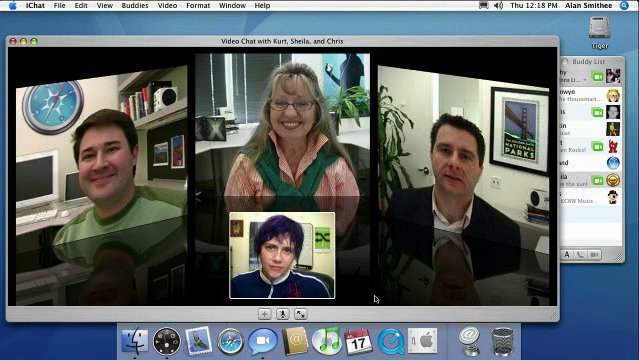
The third factor is a much more basic human system and the best way of illustrating it is by looking at the picture above. Notice how you don't have eye contact with the people that you have a conference with because the camera's perspective is slightly different to the view you would have if it were a real-world conversation. Notice how the men on the left and right are looking above their screens and the ladies are looking below, this is just enough for you to notice and process at a low level. It doesn't feel natural, the conversation won't flow as well as a real-world sit down would because the eye contact feels wrong.

This is why video conferencing can feel so wrong, even Apple's attempt at correcting it with a small mirror picture (the one at the bottom) to see how you look to the callers feels wrong.

Historically the way to do that is to have the difference between camera angle and the viewing angle of the screen as small as possible. This was achieved by using big TV screens with a camera on top and the participant perched at the end of a big conference table at the other end of the room. That's why big oil companies and George Bush love video conferencing but you're not likely to see it adopted en masse in UK homes soon.

Its also not exactly the most elegant solution, which the reason why I was really intrigued by this Apple patent which I saw courtesy of those nice people at AppleInsider.

Imagine where the screen viewing area was the camera with camera elements squeezed in between the pixels on your LCD. The back-light would provide the ambient light required for the picture, you an have eye contact with whoever you are speaking with without living in a mansion and having a conference table the size of a small yacht.

In theory this principle would also work with on mobile screens (at a lower quality-level), televisions etc. On the scary side it would also allow the omni-present two-way tele screens for surveillance like Orwell's Nineteen Eighty-Four.

Web 2.0 and the Enterprise

News.com have an interesting article Web 2.0 meets the enterprise how companies like IBM and Visible Path are using technologies like social networking, RSS feeds and wikis to help large companies build IT systems. News.com make a big show of how these 'consumer' (their word, not mine) technologies are changing the enterprise software landscape.

In addition, Forrester sent out an email newletter talking about how service-orientated architecture (SOA) (simply put: enterprise-grade web 2.0-type technologies) are having an accelerated take-up with happy IT directors to be found everywhere.

The truth is more complex than the News.com story about how the kids are showing big business the way, the process is much more complex.

AJAX is generally a hard thing to do well so it is interesting that Michael Robertson is selling AJAX-based web services through ajaxLaunch and looking to use AJAX as a way of providing applications and widgets on top of an OS. Its an interesting take from a business head on all the utopian dreams such as the network computing meme or Netscape's 'the browser is the OS'-hype back in the day and an ideal way for novices to get web 2.0 see his 'everything is moving to the cloud' keynote here which also has a good product demo (RealPlaya required).

Nice definition of what AJAX means to marketing people - 'rich web applications right to your computer'.

Tuesday, April 25, 2006

Jargon Watch and Code Sludge


MSM - shorthand for mainstream media: the kind of publications that web 2.0 advocates think will be washed a way in a sea of RSS feeds, XML data and AJAX-coded pages. It's funny how web 2.0 companies want the benediction of substantial coverage in these magazines though isn't it? Kudos to Richard Edelman.

I looked forward to the debut of Plaxo on the Mac. I think that its a great service if you use it wisely and not spam the-world-and-their-dog with it.

The product is a beta which often means not fully functional, watch out for side effects. In my case the product slowed my computer right down so that the only thing that worked was the spinning beach ball cursor and my Mac would no longer recognise my iPod.

I hope that Plaxo resolves these issues and unveils a product ready for prime-time.

Picture courtesy of CBS News.


Sunday, April 02, 2006

Fox Network: this thing that the kids are doing with MySpace its ok really


danah boyd is probably the most vocal person that really gets the whole MySpace pheonomena was interviewed on Fox Network by Bill O'Reilly a few days ago.

danah is an academic and researcher who specialises in that tricky area where people and web technology collide. I had the pleasure of meeting her when I was in Sunnyvale last August.

O'Reilly is well-known as a kind of neo-conservative Walter Cronkite with his own show called the O'Reilly Factor. danah does a good job, fair play to her. Though the cynical spin doctor in me can't help but wonder that O'Reilly may have been told to take his foot off the gas as both MySpace and Fox share the same owner?

Why couldn't Fox have used the parent to find a spokesperson from MySpace themselves?

Is this part of a larger plot to get the bible-thumping, xenophobic moral majority on side before NewsCorp's MySpace property goes all Pete Tong?

If you don't know what this MySpace thing is, the clip acts as a reasonable primer on the service and the current issues surrounding it. For further reading I can recommend danah's blog.

Sunday, February 26, 2006

Rogue IT


I was surprised when I was reading an article on Rogue IT Rogue IT may be a blessing in disguise by David L Margulius in InfoWorld. The main thrust of the article is that user implemented innovations may have value in themselves. Duh!

PCs were not shipped into companies during the late 1970s and early 1980s by innovative, far-sighted IT staff.

On the contrary, VisiCalc and the Apple II were smuggled in by middle managers to make their own lives easier and paid for out of their own personal monies or expensed back to the company.

This has continued on with web applications, PDAs, personal cell phones and pagers and wireless email.

Now web services by the likes 37 Signals to free software like browser toolbars and RSS newsreaders to iTunes provide users with easy-to-use, easy-to-implement solutions to everyday problems.

What is even scarier is the 'expert' opinion GartnerGroup How to Eliminate Five Causes of Poor IT Financial Visibility (September 14, 2005 - expensive registration required) which contains advice to IT departments on trying to repress independent thought within the organisation.