Tuesday, August 09, 2005

The rational consumer

When I was at college I did economics modules. The hypothetic models build by economists assumed that consumers made rational choices all the time. This was a marketing degree and the consumer behaviour aspect of the course dispelled this assumption. However, according to Trendwatching.com this economist view of the world may not be too far off at all.

Hygienia is a modern marketplace of mature consumers who know where what all the hygiene factors are for any good or service that they purchase. This tends towards what economists call 'perfect market knowledge' since if you can categorise the key attributes you can make a rational design based on price.

Consumers are able to cut a swath through corporate and marketing messages to get to the information that matters to their buying decision. In a way that was promised with Wired magazine's vision of the new economy, the internet has improved consumer knowledge and research. For instance gamers know that the likely European-specification Sony PSP is likely to have region-locked games and an inferior quality screen compared to the Japanese products so are using the web to buy parallel imports faster than Sony can close down their lines of supply.

Successful products and services fit into a continuum consisting of six different categories:

  • Free love - cheap to free - most of the web including Wikapedia or the Metro newspaper. The business problem this presents is when consumers become used to getting something for free how do you get them unwillingly to use a paid-for item? One of the few successes in this area would the iTunes Music Store, the New York Times Online is trying to square this circle now.
  • Cheap heaps - lowest of the low pricing - easyGroup products, Lidl, Aldi. Offerings based on discounts that are too good to be true
  • No Frills Chic - cheap but well designed - IKEA, H&M. Think cheap heaps with style and or humour.
  • Mass class - the new standard, based on products that would have been considered luxury such as Starbucks coffee, Ben & Jerry's ice cream. Whilst many brands believe this is where they sit, they often don't add up on the hygiene factors.
  • Massclusivity - the new standard for mass luxury such as adidas limited editions or personalised items like Warholised baby photos that seem to be popular with yummy mummies
  • Uber premium - Seriously rich products - Maybach limosine, a corporate charter jet and Audemars Paget watches

Monday, August 08, 2005

(Picture courtesy of Unilever)
Does my ass look like orange peel to you?

Dove's original UK execution of its campaign for beauty integrated marketing programme got a lot of criticism for voting boxes that allowed subversion of the advertising message, and was parodied by the likes of HolyMoly. Now the latest campaign for firming products based on the campaign for real beauty has prompted a great article on Slate how Dove's Campaign for Beauty, whilst pretending to be about empowering women and allowing them to define beauty for themselves merely replaces one insecurity for another.

Cellulite is a skin condition that affects skinny celebrities and bloated housewives alike, up to now it was a ' (insert celebrity name here) has it and so do I'. Heat and OK magazine thrived on bringing readers pictures of celebs as normal women. Now Dove moves the game, its ok to be curvy or old, but heaven help you if you have an orange peel bum.

From a PR perspective this messaging leaves Dove open to be criticised as hypocrites by the media and womens interest groups; empowering women as a message won't cut it, when the worm turns.

Saturday, August 06, 2005

New Citrus Technology Empowers Communications

According to news coverage of the latest campaign by Which Magazine, up to one in seven mobile phones break down within the first 12 months.


Nokia and Samsung were found to be the most reliable, Motorola and Sony Ericsson weren't. It was no surprise that mobile network 3, was found to be the most prone to defective handsets and service.


For 3's lamely spun but amusing rebuttal of the report findings go
here, for details on how to sort out your defective handset get advice here.

It was disappointing to see both Motorola and Sony Ericsson come off badly. I used to find the phones of pre-merger Ericsson used to be overengineered, robust and very reliable. In addition, I thought that Motorola had long ago turned the corner on quality from the time when they had the iconic but unreliable StarTac handsets.

Friday, August 05, 2005

Citizen Media

Its all very well talking about how blogging and cameraphones are making the average joe the new media, its another thing to build a business model around it and put your money where your mouth is. Now anyone can become a paparazzi or news photographer with Scoopt, a picture agency who promises to treat camera phone snappers the same way as professional photographers. Kudos to netimperative for the pointer.

Thursday, August 04, 2005

In The Mood For Tech

When I studied at college I was told that the chocolate manufacturers loved a recession. As people were insecure or depressed they bought more chocolate. According to News.com, Forrester Reseach has come to a similar conclusion about some gadgets. They have broken consumers down by income (high and low) and by the attitude to technology (optimistic or pessimistic). This seems to be a simplified model of their technographic profiles. The research is based on upon questioning the same sample for the past eight years on an annual basis.

I am sure that the product portfolios would shift around somewhat in Europe but what is interesting is way that the marketing channels to tackle all four groups are so delineated.
(Credit Forrester Research)
  • High-income optimists - word-of-mouth campaigns via podcasts, traditional tech hardware marketing with bulleted 'bits and bytes' lists of product features (sod the benefits) and low-cost search advertising

  • Low-income optimists - Marketers need to emphasize price and features to reach this group online or offline. Bought their PC at Aldi

  • High-income pessimists - Marketers pitch in with a simpler offer, a stronger brand and an offline approach; ideal segment for Apple then

  • Low-income pessimists - The most interesting and least rewarding in terms of average revenue per user. Marketers to target using television advertising; mainstream messages incorporating fear, greed or lust; and carefully manage their customer support costs. Does this mean that its wrong to use booth babes at tech conventions?

Wednesday, August 03, 2005

On Heavy Rotation Part Two

  • Trans Slovenian Express EP - Weird title, weird concept. Mute Records have got four Slovenian artists to record Kraftwerk cover versions. First off Laibach, who seem to have done their own Kraftwerkesque remix of one of their own tracks. The ace in the hole is Alinia - Home Computer, a definite floor filler in more jackin' clubs
  • Brett Johnson - Best intentions for failed inventions. Though the title on this release for Classic may convince you that you are buying the recording studio equivalent of the abortion bucket, you'd be wrong. Johnson has produced four tracks that have something to please everyone.
  • STLP15 - Stupendous Music - A mixed EP of dub and tech house that Worship Recordings would have been proud of.

  • Fazed Idjuts feat. Sally Rodgers - Dust of Life - First of all Sally Rodgers should need no introduction as the vocalist in a A Man Called Adam. Then if thats not enough deep house legend Joe Claussell has done the remix duties giving a piano and guitar led remix respectively.

Tuesday, August 02, 2005

On Heavy Rotation

The latest vinyl on the turntable at Chez Carroll:

  • Run Jeremy - Windowlicker - a reworking of the Aphex Twin classic so that it can be played in a house set.

  • This Ain't Chicago - Ride the rhythm - French record label Parisonic commissioned two re-tweaks of the early British house classic.... 'ride the rhythm, ride the floor, ride till you can't ride no more'

  • Incognito - Don't you worry 'bout a thing - Talkin Loud reissued this wedding standard for the 30-somethng generation, but the real gem is Out Of The Storm

  • Lovejuice - Ripped to the tits / Acid love - smiley for a record label, acid basslines. What more do you need?

  • Lorna - Jumpin jack flash - old school jack trax vocal samples put together for dancefloor mayhem by a bunch of German pranksters

  • Mario Fabriani / Majik J - Detour EP - West Coast label uses Kiwi and Italian talent to create stonking West Coast style house. I am sure there is something post-modern about this in a shipping coals to Newcastle kind of way


Monday, August 01, 2005

Something just doesn't add up

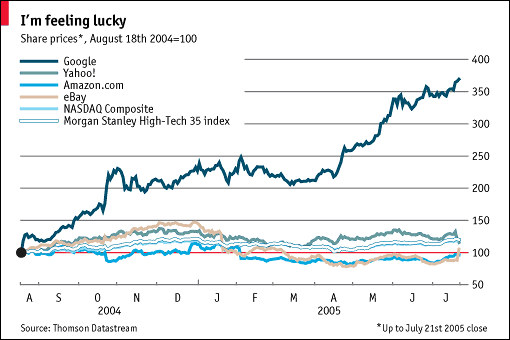
The web is now host to the world's fastest growing media format for advertising. It's what's blowing smoke up the ass of Google's share price. At the moment it accounts for a single digit percentage of advertising spend, but 15 per cent and growing of people's eyeball time.

  • Television revenues including advertising however are circling the plug hole prior to disappearing down the drain:
  • Proliferation of TV channels and transmission vehicles (digital terrestrial signals, satellite, cable)
  • Move away by marketers from brand building campaigns to direct response campaigns that produce more PowerPoint and Excel-friendly data
  • According to figures from the MPAA revenues from pay television have been declining
  • Pay-per-view demonstrating a very low growth rate in revenue according to the same MPAA

So it was with some interest that I read this Economist article Telecoms, television and the internet: the war of the wires on the way that telecoms companies are investing in IPTV as a big play to drive revenue. The figures tend to indicate that 'cable TV over phone lines' has a hard time entering ahead of it entering a mature marketplace. Telecoms companies have previously made a dogs dinner of handling media businesses, which is why they have often sought to partner with specialists in the area of online content provision. If the telecoms companes take a similar approach on IPTV then it is worth looking at the growth of the net as alternative guideline. If the previous growth of the net is anything to go by only 5 per cent of the people in the IPTV field is likely to be commercially successful with their offerings.

How will regulators handle and affect the marketplace for IPTV and how will the offering be subverted and used by early adopter consumers?

From a media company perspective IPTV is a double-edged sword, its a revenue stream, but it exasperates the 'shortening' of the window that media companies have to make money on a property. This picture becomes clearer when you read the Slate article Hollywood Death Spiral - the secret numbers tell the story.

Saturday, July 30, 2005

History in the Making

There are points in time that define society as we know it. The counterculture of the 1960s defined western culture in terms of individual achievement, respect for human rights, free speech. It pushed the bounds of visual culture and created whole new artforms in literature. A case in point is the ridiculous Howard the Duck cartoon character who was used by Steve Gerber to successfully lampoon 1970s America, post-Watergate and Vietnam through the counterculture mindset.

Some of the more surreal characters like Space Turnip and the giant bag of salt took their cue from 1960s psychedelic experiments. You can see more about Howard the Duck in this collection of the 1970s comics here in The Essential Howard the Duck.

History is a strange thing. The hippy San Francisco is now a sad psychedelic shopping mall of die dyed t-shirts and new age paraphernalia. The culture being blamed for everything from loosening modern moral values to the corrosive nature of materialism on society.

Having lived through and participated in the UK's rave culture in the late 1980s and early 1990s as a clubber, DJ and promoter, I have seen a similar kind of thing develop, however property developers have done the rave generation a back-handed favour by redeveloping their icons like the Hacienda into a different format that could not get trapped into the tourist circuit. The cash-ins have largely been quite sublime, such as Warp's very good collection of early house tracks 10+1 and 10+2. Matthew Collin's book Altered State for me remains the best written book about this era.

Now the dot.com era is looking as if it may be starting to define itself in a similar way. Wired magazine, the Whole Earth Catalog of its day for the net generation has a ten-year netrospective (geddit) in its latest issue (Wired 13.08: 10 years that changed the world). Fortune has an interesting oral history Remembering Netscape: the birth of the net. The participants are rushing in to define their own place in history knowing that these articles will be the ones used by authors in the future when they write about how the internet changed the world. Again having played a role in that time, as a PR consultant working on a 'new-chip to blue-chip' client base as we called it at the time, I got an interesting overview of the sector and inside view of some of the major players. I am sure the future will be viewing this history through distorted vision based on the tinted recollections in these articles.


Monday, July 25, 2005

From White Heat to Flickering Flame

It had been too long since I read Peter Cochrane's column on Silicon.com (which I noticed has changed descriptor from 'column' to 'blog' in line with the latest media fad).

In his July 14th posting he talked about the pace of innovation that has been running at break neck speed since before Harold Wilson's 'White Heat of Technology' electoral campaign in the mid 1960s through to the internet age.

Whilst Cochrane disagrees with the evidence about this decline, he links to some interesting reading that supports the hypothesis here. Richard Holway (of the Holway Report fame in IT journalism circles) of Ovum talks here about how innovation is cooling the technology sector innovation and market value.

Jargon Watch

Cold tech - issues and technologies that 'shrink the technology pie' such as 'free software', the runaway nature of Moore's Law creating computers more powerful than needed by busineses since software has failed to progress at the same rate and offshoring of jobs to developing economies. Credited to Pip Coburn of UBS based in the US by Richard Holway.

Sunday, July 24, 2005

Beyond the Low Riders

The New York Times has an interesting article about how Sean Coombes is trying quite successfully to walk his urban fashion label out the cliche it had become. Though his business is worth some 400 million USD annually, Coombs has seen the writing on the wall of the scene and rather than cater for the limited market of Ali G impressionists is trying to move more upmarket. The urban fashion scene has become as tired as the sound of R&B and rap music, in the way that 80's rock got into treading the same groove over and over again to make money.

In the US, labels like Ecko, Sean John and Phat Farm have been co-opted by preppie clientele. There is a certain irony in this as Phat Farm often aped preppie and collegiate looks for the hip-hop community. Now Phat Farm has been co-opted by desperate brands such as Motorola looking for a hook-up, Russell Simmons sold out leaving the company to an international conglomerate. Brands like Gap and Abercrombie and Finch have stolen much of the look and in Europe, genuine workwear brands like Carhartt and Dickies that were part of the real prison yard baggy look have combated the new pretenders by acknowledging their fashion customer base and participating in associated activities like music and extreme sports.

Coombs is using his womenswear range as a Trojan horse to get into the department stores that otherwise would not have carried his usual clothing range.
-
Reading the Tea Leaves

The Buttonwood
column in The Economist has some interesting takes on the current interest in internet stocks again. The column puts forward data from both the bull and bear point of view regarding internet stocks: Interesting take-outs:
  • Forrester Research figures quoted:
  • That in the US people spend about 35% of their media time online but that this attracts on 6% of advertising spending
  • Internet advertising in the US was worth about 12 billion USD in 2004, it is likely to grow by 25% in 2005 and tail off to single digit growth by 2010

Research quoted from the bear side of things indicated that:
  • People are less likely to give out their details online. Of the 30% who used online banking, many were now using it less and 14% had stopped using it for paying bills (GartnerGroup)
  • 18% of Internet users had stopped shopping online due to the fear of internet fraud (Financial Insights)
  • Even online dating is down in the US (Jupiter Research)

Saturday, July 23, 2005

Level 3 to Crooked E?

Totaltele.com had an interesting report from Dow Jones Newswire how Level3 the backbone network provider had been exhibiting Enronesque traits. Level 3's capital-intensive business model is questioned (subscription required) by Helen Draper highlights how Level3 is having to invest huge amounts of money to make just a little money back, hurting its working capital.

This was one of the factors that encouraged all the creative accounting at Enron. This is particularly interesting as Level 3 was both a supplier of capacity to Enron Broadband Services and at the same time its CEO James Crowe was a vocal critic of the Enron Broadband Services business model according to journalists that I had spoken to.

Friday, July 22, 2005

Smart Futures

AlwaysOn have a number of great webcasts from the AO Innovation Summit 2005 in Stanford. I was particularly interested in the discussions on smart phones.

Outtakes:
- I loved the description by one of the speakers about changing the names of smartphones to 'social computers'. Whilst this was true - its a computer that is used for socialising, the phrase tapped into the lingua franca for the latest technology hot topic 'social applications' from social networks to tagging impressed the spin doctor in me.

- Seagate spoke about the rise of having a hard drive in cellphones, which I thought I was quite interesting, I can see that the continuing reduction in price of Flash and keeping a decent battery life is going to squeeze the opportunity for hard drive manufacturers

Converging Functions
- Opportunity exists for both converged and dedicated products. Both will co-exist because of peoples different needs
- Simplicity and integration were considered to be two key drivers for successful converged devices

Storage
- Terabytes on the phone will be driven by the ubiquity of smartphones
- Smartphones is currently outsold by 'feature phones' by 10-to-1

The Killer App
- Trip Hawkins - social networking (IM, Blackberry, voice), benefit improving their social life

Monday, July 18, 2005

3 G games

A couple of interesting articles appeared on the Mobile Pipelines website that when read together paint an interesting picture about 3G services. First up InStat the analyst house had done some consumer research, basically only an eighth of consumers were interested in using mobile video services. Customers who were brand loyal to their carrier (ie: had the most long-term value, were also the ones who expressed the biggest disinterest in the mobile video.)

Secondly, mobile carriers are interested in getting MVNOs (mobile virtual network operators) on board. Content experts like Disney (confirmed) and Apple (speculative) to drive usage of their networks. This reminds me of work that I did back at the end of 2000 around a report called Developing Winning Strategies in a Connected Society. In the report, over a 100 CEOs questioned admitted that they thought broadband in its broadest sense important, but DIDN'T know what the killer applications would be that would drive adoption. In essence they were betting blind that technological progress wouldn't screw them over, not a particularly wise bet to make in the telecoms sector in recent years.

Mobile phone operators seem to find themselves in a similar position, by getting content MVNOs on board, they can defer the cost of rolling out 3G networks and observe how successful services can be developed (or not), as a kind of free skunk works. What is more the content experts take over some of the risk that the telecoms companies have found themselves lumbered with.

Sunday, July 17, 2005

Despite the dross, web still useful

The New York Times has an interesting article how consumers are simply replacing Windows PCs that are cluttered with spy/mal/ad-ware. The article Corrupted PCs find new home in dumpsters highlighted a number of cases included an internet industry professional, a doctor (who migrated to the Mac OS X platform), a stockbroker and a bank manager.

What is interesting is from the article is that:
  • The internet was still sufficiently useful that decided to use it inspite of their bad experiences. Not one of them questioned the benefit of using online services
  • Not one of them blamed the poor implementation of security on Windows (ie a product defect), they accepted that using IT equipment is a shoddy experience
  • An adequate PC for using the internet is now so cheap that it can be considered a disposable item, getting adequate tech support or software protection is too expensive to make it viable, which has got to be a bitch for people selling more secure products (Longhorn) or security products (Symantec, McAfee etc)
  • By inference there seems to be little upside for many consumers in paying a bit extra for a safer computer platform like the Macintosh
  • Consumers are putting relatively little value in the data that they have stored on their computer, if they are willing to just skip the old one and buy a new one like a toaster or a microwave
The UK can have a crack at the big time

When I first saw this Deloitte report talking about the opportunities available to the UK my immediate thoughts about the language and imagery used in both the title and the front cover, were that the authors were trying to invoke the promising loser status of British tennis players like Tim Henman.

The ball's in our court highlights the precarious nature of the UK technology sector, since the industrial age Britain has been on a decline in the global sense of technology leadership. We do have bright designers, made world changing developments and there are some bright sparks in the technology sector like Glaxo and ARM. However for every technological leadership success there are more high-profile failures: Thorn EMI, GEC/Plessey/Marconi and ICI to name but a few.

The report does not make surprising reading. Britain has been very successful in selling technology (which is essentially what Vodafone is), but hasn't developed its own Intel or Microsoft. Qinetiq is cited as one of only two organisations involved in IT research.

Whilst the UK has a developed financial industry that does invest in technology, the reports measured criticism of the sector in supporting the technology sector will be familiar to anyone who has read the criticism of the short-termist approach to capitalism in the UK by the likes of Will Hutton. Venture capitalist outfits come in for particular criticism, the report says that they could do much better if they had the required industry knowledge to complement their financial skills

The report cited a decline in the past five years of UK headquartered technology companies that contrasted with the performance of foreign based companies:

a growing cause for concern is the performance of UK-headquartered technology companies which, in cases, have fared poorly over the past five years. Simultaneous to a host of foreign-headquartered technology companies' strong growth, UK headquartered companies, have disappeared from the UK's public markets. Similarly, while there are many UK-based multinationals generating a billion pounds or more in revenue each year, only a small handful of UK-headquartered companies have managed this level of turnover (such as O2, BT, Capita, Sage and Vodafone).

You can read the full report here
Peak Oil goes mainstream

Hubbert's Peak Oil theory was developed by a geophysicist Marion King Hubbert to model how oil would run out. The issue has been discussed for a long time in oil circles, and widely accepted as truthful based on how Hubbert modeled the decline of US oil production based on a peak in the early 1970s. Hubbert had made this prediction back in 1956. The Peak in question is the top of a 'bell curve' (see picture) used to model production, the model can only provide approximate values because the oil production data available is usually estimates and can vary considerably in accuracy. Interestingly the combination of Middle East instability and the rise of the Chinese economy has brought the discussion of 'Peak Oil' into the mainstream culture. Rolling Stone magazine (yes, that Rolling Stone) has an article here called 'The Long Emergency'. The article moves beyond Hubbert's Peak to explain what a post-oil US economy may look like and it ain't pretty.

Pretty good book review of Hubbert's Peak by Kenneth Deffeyes can be found here. The book can be bought on Amazon here.

More information on Hubbert's Peak can be found online here.

Thursday, July 14, 2005

Movie Companies Surprised That The Pips Didn't Squeak Despite Squeezing Customers

Business Week has a great article onlinethat suggests that movie companies have not learned the lessons of the music industry. DVD sales are declining because the format is too expensive according to evidence provided by Business Week readers. Both Dreamworks and Pixar have noticed a decline in disc sales. Box office hits like The Incredibles have underperformed in the retail environment.

Substitute products including cheap rentals is threatening the film studios licence to print money, expensive DVDs and a proliferation of 'special editions' are leaving customers feeling ripped off and shy of making the same mistakes in the future.

Wednesday, July 13, 2005

Y U Consume?

Knowledge@Emory has an interesting article for marketers about targeting consumers. Sounding like something out of the 1950s 'Tactics To Tackle The Teen Market' has some interesting case studies and common sense outtakes.

In summary:
  • US 'generation Y' consumers (born late 1980s and 1990s) were responsible for spending 169 billion USD
  • A lack of parental time is driving up the amount of money that teens have to spend as overworked folks resort to cheque-book caring
  • Teens are trendsetters defining tomorrows hit products
  • Teens don't liked to be treated by brands in a condescending manner
  • Teens want 'truthful' advertising
  • Teens willingness to experiment offers an opportunity to new market entrants
  • Online advertising is a more important media to reach teens
  • Don't try and BS them

Tuesday, July 12, 2005

The Coolest Smartphone You've Never Seen

Singapore-based technology company Qool Labs Pte Limited is a PalmSource licencee who makes a really sexy looking PalmOS powered smart phone called the QDA 700. Ok, their branding needs work, but their product design certainly doesn't. The phone has a spec that would shame a Treo and doesn't look like half a house brick and as you can see from the advertisement the QDA 700 has a built-in sultry babe magnet making the owner instantly irresistable.

Get this, they DON'T sell it in the UK or in the rest of Europe from what I can see. Not even Asian import specialists like Expansys sell it. It sells in Singapore for about 649USD. In addition, they have not licenced synching software for the Mac, like as if someone who likes their technology that stylish would use a PC?

The call to action, help Qool Labs help themselves

Send a polite email to Ms Edna Ng on this email address explaining that you are interested in the QDA 700, you are based in the UK and would like to synch it with a Mac.

I reckon once they are convinced of the market demand the rest will follow naturally. Even if they don't know it, Qool Labs need and deserve all the help they can get to bring this product West as part of a successful push for smartphone worldwide domination. Abuse or praise in the comments section please :-)

So Simple Anybody Could Have Thought of it....

But they didn't. Coca Cola is a brand that is an icon, the visual language of the logo font is instantly recognisable. It also harks back to the 30-year old campaign of I'd to buy the world a Coke. So why these haven't adverts haven't been run before is beyond me.

Last year's Coke adverts were made up of those oversized illustration doodles that seem to be de rigeur amongst shop window designers at Harvey Nichols and Top Shop.

This execution was photographed in Tottenham Court Road tube station, I have also seen it on 48-sheet poster sites. Budding advertising critics can comment below.

Monday, July 11, 2005

Its Spring Time

Japanese watch nut Seiya Kobayashi has an interesting new Seiko model on his website.

While the dial and case design looks like a dogs dinner, the spring drive at the heart of the watch is an interesting answer to the question of making a mechanical watch as accurate as a quartz watch.

I contributed an explanation of how it works to Wikipedia
here.

Each movement is hand made by one of 10 trained technicians, which the main reason why it costs an eye-watering 2,598USD so don't expect down Ernest Jones or H Samuel just yet.

e-Commerce grows up

The New York Times 'A Retail Revolution Turns 10' feature is a concise warts-and-all history of how Amazon grew to become the dominant player in e-commerce. Bezos unlike his contemporaries has not been replaced as the head of his company is shown to be a major issue and a major asset at the same time.

The New York Times graphic above shows how the business expanded based on a 2 billion USD bank loan via a business strategy that reads like a high-finance game of chicken.

Sunday, July 10, 2005

Gadget Cooldown

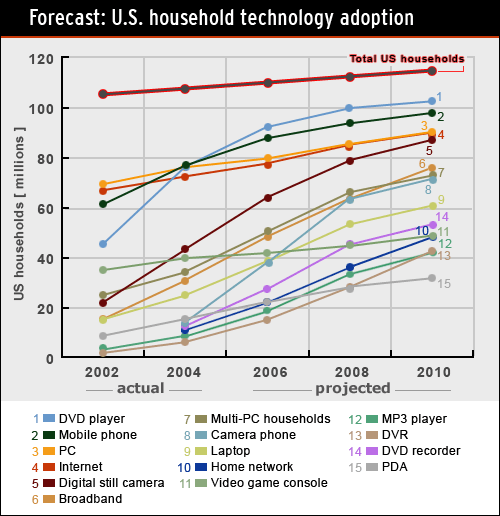
The growth in the PC market has been driven by the latest items that are the new hotness that will be old news in a matter of months. This PC-style economics has driven its way into the consumer electronics market over the past few years with items like the iPod and digital cameras.

For a while there has been a bit of a counter-culture against it with things like 'low fi' music making that takes advantage of older computer gear (check my friend Thomas Margolf's site here for more information). In graphic design old style cut and paste collages, hand drawn illustration and 8-bit computer graphics are used to reference older and 'cooler' ways of doing things. Vinyl is the music format that refuses to die despite the best efforts of the record labels and has seen a resurgence through people like Simply Vinyl. It is with a certain amount of schadenfreude that I have observed over the past few years how record companies have alleged that digital piracy is hollowing out their business, when they gave away the keys to the vault in the 1980s by trying to force everyone to upgrade to CD in the interest of leaching every last penny from their back catalogue.

Publications like Make by O'Reilly Publications in the US has tapped into a pent up demand for people to be able to get back into their sheds and start tinkering about with their stuff again, something that the modern iPod or digital camera design does everything to discourage.

If Tony Glover is to be believed in his article 'Sanyo Hit As Buyers Snap Up Second-Hand Cameras' for The Business there is a mainstream gadget backlash underway as consumers have tired of gadgets that are passe in a matter of months.

The pace of product replacement cycles has been set by the IT industry and there is a danger this will result in customer fatigue. Consumers are unenthusiastic about replacing expensive handheld products almost before they have learned to use them.

Evidence of this trend emerged last year with many consumers preferring to buy second-hand products such as vinyl records instead of CDs. Some retailers say the trend has begun to spread to digital cameras, with a growing number of customers buying second-hand classic cameras in preference to the latest digital marvel.

Conclusion: As my friend Heather would have put it: sucks to be a gadget-centric company like Sanyo and Casio (whose Casiology brand campaign is a painful exercise in trying to re-engage with the yoof market). It is good news for 21st century flea markets like eBay and Amazon's Marketplace service.

I am not too sure if this consumer fatigue will stop at the latest techno-toys, I had lunch with some friends today. They are by anybody's standards well-off. My friend was wearing a fake Panerai chronograph, so well made you could not tell the difference that he had bought from a replica watch website. He already owns a Rolex, and being able to afford the real thing was not the issue. It was more a kind of anti-consumerism, I have one good watch I find it hard to justify to myself why I should buy another?

Leave a comment and let me know what you think.

Saturday, July 09, 2005


Technology Rally of 2007 apparently

John Dvorak has written an interesting article on Marketwatch. In the article John does a critique of why the technology market is currently stagnant and outlines what he believes will be the main drivers to kick it into action in 2007.

I have summarised some of his ideas below and added my own comments as well, (please feel free to post your thoughts in the comments section).

Wireless - Bit of a no brainer this one, new variants of 802.11 and WiMax will be key drivers. I don't know what its like in the US, but in the UK public Wi-Fi hotspots are damn expensive, this will need to come down to spur adoption further. Corporate users in their own offices are expected to be key adoptees 802.11N according to Dvorak. WiMax is expected to compete with broadband in a more cost effective manner, creating a new range of alternative telcos. Pretty much the same claims for other technologies like free space optics etc.

Processor technology - Bit of a dichotomy here, but first of all Dvorak puts the sluggish sales of PCs and laptops down to the fact that computers are 'way too powerful for typical mundane use' except by CAD/CAM operators and Photoshop jockeys. Then he goes on to talk about how multi-core processors are going to be one of the drivers that pushes the tech rally of 2007. Go figure

IPTV - video delivered via IP networks. This is a big buzz phrase with technologists. In the UK, it has been rolled out by Homechoice, whilst technologists get all utopian about content being free and ubiquitous, network management technologies and government regulations will act to stop traditional media businesses from being swept away. Microsoft sees this as a way to get ahead in the set-top box business.

VoIP - again a no-brainer, Dvorak pays lip service to the inevitable move away from circuit switching to packet switched voice networks. This will lower the price of voice calls and lower the barriers to competition, but will be stymied by telcos increased ability to control their IP networks, expect telecoms OSS companies to offer telcos the opportunity to apply old-style billing models on these new services and adversely affect the QoS of competitors like Skype trying to piggie-back on your existing broadband connection. Again government regulation will also work to control VoIP.

Microsoft Longhorn - 'triggering an upgrade cycle that will be doubly powerful as the MacOS becomes a threat to Microsoft, forcing it to become more competitive'. Dvorak makes three bad assumptions with this statement:
- Longhorn will be a must-have upgrade for business and consumer PCs. This is not as clear cut as it seems because Longhorn's most vaunted features are being cut to make the product ship broadly on time
- The MacOS will sudden become more of a threat to Microsoft. Dvorak assumes that Apple will overnight change its business model to a Microsoft software business and that the likes of Dell and Sony would fall over themselves to distribute it as an OEM product. Ventures like Be Systems and even the Linux distributors will tell you what an uphill battle this is
- Speaking of Linux, Dvorak's statement implies by omission that open source competition will no longer be a competitive factor. Dvorak has missed out on the social factors that ensure software adoption. Microsoft's dominant position is helped by the Microsoft Certification Scheme for IT people. Linux is increasingly becoming part of the professional IT persons skillset, BSD and MacOS X doesn't have the same skills base in business to spur adoption in the same way

New video compression standards triggering even greater enthusiasm for file sharing of movies and TV programmes. Well I guess that this could increase broadband take up and consumer storage requirements, but not too sure that it will be spurring a technology rally, especially after the US high court's ruling on the recent Grokster case

Location based services because of the GPS modules which will be widely embedded in new phones, expect a nightmarish scenario rather like Tom Cruise in Minority Report where personalised adverts respond to him as he moves through a shopping mall. Gee thanks, that sounds appealing.


The
B-Boy Posting

Like trouble, great websites often come along in threes. Over the past few weeks I have found three great sites.

Bournemouth based breaking crew and record label Second To None have a great web site that you can view here. The site also includes MP3s of mixes done by DJ Junk, you can buy the vinyl directly from them a lot cheaper than other shops and their service is the business.
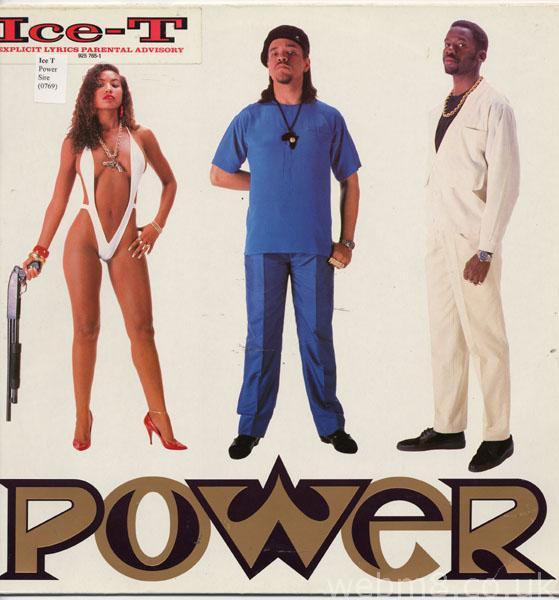
I had to share this cover with you which is a parody of Ice T's break out album Power (which pretty much wrote the book on gangster rap, even though Ice T meant it to be social commentary as satire).

Power Moves has some funky ass tunes on it based on classics like Hijack's Style Wars and Hardnoise's Untitled.


Talking of Hijack, DJ Supreme the scratchmaster who gave their records an unparalleled sound has his own site. It features clips from his forthcoming DVD history of Hijack; a live performance from the Montreaux Jazz Festival and an old pirate radio set with Kamanchi Sly laying down lyrics over the top.


Finally Richcolour has pulled together a fantastic collection of old mixes and pirate radio adverts on this site featuring the likes of Steinski, Froggy, Les Adams and a very young Tim Westwood.

Friday, July 08, 2005

Jargon Watch
Terror task - a mindless, highly interruptible background activity that's possible to perform and feel vaguely useful since you're sure as hell not doing any real work while responding to the stream of "are you OK?" emails & SMSs, and refreshing RSS on various news sources. Kudos to Paul Makepeace

Wednesday, July 06, 2005

Podcasting - only for the headstrong

Following the integration of podcasting in iTunes 4.9, the Wall Street Journal's famous technology writer Walter Mossberg investigated how hard it would be to make a podcast. It ain't easy enough for the average joe to do, in addition new podcasts can take up to four days to show up on iTunes.

Interestingly Mossberg's article on this was also syndicated on TotalTele.com; a news service aimed at the telecoms industry outside the U.S.

Tuesday, July 05, 2005

Revolution Postponed

I don't visit Red Herring online as much as I used to, but noticed today that they had decided to finish their blog on June 23rd. The blog had been running for the last year. I checked on Yahoo! News, Google News and there was not one article about the blog being shut down, nor did anything come up on Technorati. Unread or unloved? I don't know, but it is interesting that the media business heads in their wisdom decided to terminate this experiment after giving it a reasonable amount of time to mature and develop.

Is this just another part of the puzzle showing that blogging is not the media revolution its 'long tail' evangelists would have you believe?

Monday, July 04, 2005

eBowed

In an interesting turn of events both Wired News and equity analyst Safa Rashtchy of Piper Jaffray in the latest issue of its Silk Road newsletter wrote articles that showed the success story of eBay is starting to develop cracks.

Power Sellers are looking to alternative outlets, onerous fees, online fraud, a desire for a differentiated shop window and declining margins have made the online marketplace lose some of its appeal.

Is eBay still the daddy, or is it showing its age?
Gaming the System

The FT has a review of Buzzmarketing by Mark Hughes. Hughes was a marketer at a dot.com (Half.com) who managed to avoid blowing their money on brand building ads, relying instead on creating a buzz through marketing stunts.

Reviewer Gary Silverman takes the review in an unusual direction as he uses it to critique the media industry and its reliance on traditional advertising as its main source of revenue. Silverman recognises that this is an ever shrinking pot and rather than helping journalists with compelling stories, buzz marketing techniques are undermining the business of journalism.

Meanwhile the New York Times has got a great article that shows how the very innovation that helped grow Silicon Valley is now aiding competitors. Despite improvements in profits and growth for valley companies, the number of jobs in the region has fallen by 10,000 since last year. Software engineering being hardest hit.

Monday, June 27, 2005

CSR Showstopper

Its easy having worked in the media to lose touch with what happens in society. When I read in the FT on Saturday about Greggs the Bakers' school breakfast clubs I was impressed and disturbed at the same time.

Firstly the disturbed bit, I went to school in a hardship hit area where many kids queued to get free school meals, I managed to avoid it myself as my Dad managed to keep working. The recession hit 80s I thought were long gone, its a lot easier to work now. The breakfast clubs reminded me that the child poverty one associated with my parents day and before despite family credit and new deal schemes designed to alleviate real poverty. It seemed like something one would have expected when there were the dark satanic mills and dank industrial landscapes portrayed in LS Lowry paintings and sketches where working-class people toiled on the edge of existence and children were at risk of catching rickets and got their shoes from a 'boot club'.

I was impressed
by the way Greggs have taken positive steps to help communities deal with this by funding the food and equipment like toasters and having their own staff train volunteers who cater for the breakfast clubs. Breakfasts improve punctuality and help the children concentrate on their morning lessons, since many of them would not have eaten until lunch time. The campaign seems to be a text-book case of corporate and social responsibility activity. Apparently the scheme costs them in the region of 250,000GBP per annum and puts to shame the Big Food companies who have far more resources at their disposal and are in desperate need of far more goodwill.

What do you think?

Sunday, June 26, 2005

The Rod For Sony's Own Back

Sony is busy trying to close down the UK and European grey market for Japanese market version Sony PSPs. Grey market devices are an ingrained part of gaming culture, the real hardcore fans want to have the latest and best, in the same way that movie fans will buy region free DVD players to watch the latest US and Asian DVD releases. One could assume that Sony rattling the cages of grey importers was just a way of keeping the PSP buzz going through to the much delayed European launch. However according to gaming fans interviewed in Saturday's FT its as much as about not getting a substandard gaming experience. Japanese model PSPs are alleged to be able to play games from any region and to have a brighter and clearer LCD screen than those planned for European customers. Instead of a buzz, Sony has managed to leave a bitter taste in the mouths of many of the influencers it would look to evangelise the PSP in Europe.

What do you think?
Jargon Watch

I haven't seen this sort of feeding frenzy since PR agencies started throwing a wobbly about how to get their fingers into the corporate website design pie with online press rooms and the like.

efluentials - a word owned and used by Burson Marsteller to describe bloggers, people who subscribe and contribute to email newsletters, bulletin boards etc. Kudos to grizzily journalist David Tebbutt

Saturday, June 25, 2005

Dearly Beloved we have gathered here.....

Jon Marsh, front man of The Beloved has put many of their old demo tracks and unreleased mixes online as MP3 files. There is also a news section that keeps you up to date with what The Beloved are now up to.

Particularly worthwhile is the demo version of Time After Time and the Radio 1 mix of The Sun Rising.

The Sun Rising is probably the closest to perfection that a pop song has ever become...
Jargon Watch

Mommy consultant - Not an advisor to the idle rich telling them how to look after their children between nannies. Instead it is the name given by some Silicon Valley inhabitants to experienced female PR consultants who have chosen to go freelance and balance PR with having children. Partly a result of market where is a surfeit of people with five plus years experience. Kudos to SiliconValleyWatcher.

Friday, June 24, 2005

The Michael Jackson Posting

Like the Fatty Arbuckle and OJ Simpson trials before it, the celebrity trial of Michael Jackson seems to have divided opinions despite the not guilty verdict. The most outspoken view I have heard is this diss from NY underground MC Necro based on Billie Jean. I don't agree with the sentiment but respect the rap delivery.

What do you think?

Monday, June 20, 2005

Just brilliant

This originally came off Response Source; an email list that connects journalists on tight deadlines with PR agency folks who have clients to sell.


-=-=-=-=-=-=-=-=-=-=-=-=-Query-=-=-=-=-=-=-=-=-=-=-=-=-
PUBLICATION: C Weekly

JOURNALIST: sally flood (freelancer)
DEADLINE: 20-June-2005 at 18:00 (GMT)
COUNTRY: United Kingdom

QUERY:
Urgent message to the PR called REbecca who called me this afternoon
about
the CW business continuity feature...

HANG UP YOUR PHONE!

While i'm very much enjoying listening to you and your colleagues
chatting
away about your holiday plans, I have work to do and sort of need my
phone.


ps - good luck getting the time off in august.


thanks

HOW TO REPLY:
Email: mailto:mail@sallyflood.com

-=-=-=-=-=-=-=-=-=-=-End of query-=-=-=-=-=-=-=-=-=-=-=

Sunday, June 19, 2005

On heavy rotation

Not really on rotation at the moment as the decks and set up is in disarray until the last of the shelving goes into the garage / utility room. Many of my recent purchases have been stocking up on old gaps in my collection and getting fresh pressings of old favourites.

However here is the new stuff:
  • Tayo meets Acid Rockers Uptown - Rockers Delight (Fat) - Dubbed out acid break madness
  • Westbam and Nena - Old School Baby (Low Spirit) - German legend DJ Westbam had this track featured on a Fabric mix album and the reviews went ballistic. It isn't bleeding edge stuff, but it hits the spot
  • Martinez - Shadowboxing (Automatique) - The kind of quality deep house you would expect from an artist that has had their records released in the past on Guidance
  • Jordan Fields - Re-edit series (Loft 66) - Quality re-edit EP with something for everyone on the 12
  • Sistema - colores en capsules EP - (Factor City) - Spanish house music that is good enough to take on the best of the US.
  • mr bfennd - rock the roses (white label) - Outkast vocal over The Clash. Works really well
  • The Fort Knox Five - Radio Free DC (Fort Knox) - The A-Skillz and Krafty Kuts mix is what it is
  • Various - Summer 2005 sampler (Brique Rouge) - Buy it for the Alexkid track Flute which will not be released
  • Henrik Schwartz - Jeff (Zepplin) - German deep house, interesting JuJu Christian track on the flip
  • Del Costa & Pedro Goya - 37 (Classic) - Percussive house cracker, very 80's sleeve though
  • DJ Pierre - This is house (Essence) - talking house record, builds and rocks nicely
  • Simon Nedeczky - Tribal Sunshine (white label) - single sided percussive house track, very Ibiza
  • DJ Vitamin D - That Latin Track (Estereo) - Balaerics in the house
  • Jerry Ropero & Denis the Menace feat. Jaqueline - Coracao (Nero) - Get it for the Axwell mix
  • Francois K - Mindspeak remixes (Wave) - Its similarity to Jamie Principle's Baby Wants to Ride hooked me in

The Crazy '99


The Crazy '99
Originally uploaded by renaissancechambara.
Picture courtesy of Jener Miranda from the 2005 class year book of Paul Revere Charter Middle School in Los Angeles.

I got an email from an old colleague of mine Jener Miranda. Jener and I used to work together at a then very successful PR agency called The Weber Group Europe on 'traditional' enterprise software type technology clients and newer 'boom' clients in what where then bubble areas like mobile software, e-commerce, web services and alternative telcos. Jener moved back to the US and eventually left the public relations agency game for a more fulfilling career inspiring and educating kids. As you can see from this years class year book photo, he's a firm disciplinarian. Jener's email and recent articles that I have been reading threw me back to those times in 1999 when we worked together.

There are a number of factors that are piling on the pressure to repeat the past. VC firms are being more adventurous with their funding, mainly because if they don't spend the money soon they will have to give it all back and won't be able to charge management fees. Hundreds of millions of dollars are at stake. This means that they are incentivised to invest it in something.... if they are desperate enough anything.

The VCs bargaining position is not helped by the fact that many of the most promising investment opportunities do not need them, having been bootstrapped together rather like Jim Clark's Netscape. VCs that previously specialised in traditional areas such as enterprise software tools, photonics, wireless technologies and telecoms are looking to get into consumer web ideas.

There is too much money chasing too little investment opportunities (for example the hype surrounding the Party Poker floatation and the amount of wannabes launching in its wake. (I know of two at least that friends of mine have been approached to work on that are Party Pokeresque vehicles funded by investment bankers and hedge funds who smell blood in the water.)

Social networking has already seen a boom and the first casualties occurred last year like Buddy Network and Pollen in the UK alone.

Much of the technological areas that were hot when I cut my PR teeth are hot again: PC-to-PC and PC-to-phone communications, shopping comparison sites and online calendars to name but a few.

Watch-outs
- When the company becomes the product. During the last boom many of the start-ups goals were to have a swift exit strategy and the business may have been set up with an investor in mind (usually Cisco or Microsoft). With this mindset the management move from building a viable business with real sales revenue, to being focused on one sale: being bought by someone else
- The use of accounting measures with key numbers missing becomes de riguer: repeat after me EBITDA positive is not necessarily a profitable business
- Common sense and the laws of economics no longer matter (allegedly). I still have Wired magazine's encyclopedia of new economy reprint with the Rockwell painting cover somewhere. My defining dot.com story was when I met one of the management team of an incubator fund. We had so much work on at the time we used to vet new clients. At the end of the meeting I asked him what made his differentiated his outfit from competitors to which he replied that he was really surprised I had asked the question. They were too busy to think about and were focused instead on moving at internet speed
- Ideas that focus on the technology, not on people. Online banking works because people can easily see the numbers of their statement in front of them rather than having a boring litany read them from a call centre in Bangalore. Ordering a pizza by WAP doesn't, you already have a phone in your hand, just call up Dominoes instead

The first signs are that this is already happening.

I met a merchant banker who said that the collective memory of institutional investors and experts went back about eight years. We are over the eight-year threshold since the madness of the Netscape IPO first took hold.

Are we due another net bubble? Let me know your thoughts.......

Sunday, June 12, 2005

The Mac Is Dead, Long Live The New Mac

Picture courtesy of Apple Computer Inc.


Last Saturday evening, my trusty iBook G3, gave up the ghost in spectacular fashion, I needed a replacement machine sharpish to do work from home. This meant that the usual online shopping expedition was off the cards.
A trip over to my friend Steve on Sunday morning established that I hadn't been doing anything stupid and that the hard drive was dead. The drive could not be resurrected with DiskWarrior.

Its now Sunday afternoon, what do I do? Sack off going to see Sin City and head on down to the Apple Store in Regent Street.
'I want the cheapest system that I can get running'
'No I do not want a warranty'
'I do not want a more expensive machine'
'Yes I do want additional memory fitted today'
'No I do not want a warranty, or overpriced technical support'
'No I do not want an overpriced Apple display'

Then off to Tottenham Court Road to pick up a monitor, where it is virtually impossible to find a shop that stocked them, eventually Maplins came good.

In the meantime, Apple removes the 256 MB DIMM from the memory slot and upgrades it to a 512MB DIMM

I cart it all back to the ranch:
- The mac mini has Panther on board, so I need to upgrade the
Operating System as well as uploading my applications.
- Fortunately I had my mail on an IMAP account so it was all held server side and my .mac account re-dumped my diary, to do list and address book down on to the new machine.

10:35pm on Sunday night finally sorted, just the work to take care ofthen...
Viral Craicer

I may be the only straight man in the UK who thinks that Rachel Stevens isn't the cats meow. She's nice, but doesn't float my boat. However this viral done in Flash gets my vote for the most positive use of suggestion and double entendre. Kudos to young Jonathan.

Saturday, June 11, 2005

A tale of two microchips

OK, I was wrong. My rationale focused too much on Intel's present difficulties and techology. Apple is moving to Intel processors, the rationale behind it is being endlessly debated in the media but there was some interesting strands that I wanted to pull out:

  • At the present time the PowerPC is a great architecture, none of this is about the chip design, but about investment in chip manufacture. Jobs in his keynote focused on the suppliers product roadmaps and computational performance versus energy consumed (and dissipated). Intel is looking to make powerful efficient microprocessors in the future, suitable for mobile applications. IBM wants to become a one-stop shop for ASIC design and manufacture
  • The Power architecture will continue in some of the world's best servers and mainframes, vindicating its microchip heart. But then you don't need to have a mainframe sitting on your lap while you read your email on a commuter train
  • IBM stopped development of Apple's processors because the business was unprofitable
  • Sony tried to sell Apple on their Cell processor and failed. Jobs is supposed to have not liked the architecture. Moving the OS over to a new concept like Cell would have been a bet the farm move that would have given him little room to move. Sony would have liked to have Apple on board to increase capacity in their own chip fabrication plants

Essentially what all these points boil down to is this: the process of making micro-chips is becoming more and more expensive. This is reason why the electronics industry has seen the rise of the 'fabless' chip company over the past ten years. Once you have the engineers, designing a chip is relatively inexpensive with the rise of powerful, cheap off-the-shelf computer workstations with specialist software. For ASIC designs, some of the software is available as a free download. However, pushing the bounds of physics to get more components on a smaller piece of silicon to work properly requires a huge amount of money. The ability to manufacture microchips is becoming ever more concentrated in the hands of fewer players. Apple never represented more than 3 per cent of IBM's chip fabrication capacity according to reports I have seen online, so it was a no-brainer for them to lose Apple and focus on larger volume players like games consoles.

Interesting questions:
  • Why has Sun's SPARC architecture or Fujitsu's flavour of it not come up in discussions. Sun would benefit from having an addtional customer for the SPARC architecture and the RISC to RISC move would have been well received in the Mac community?
  • When can we expect to see the first PC rejecting a chip architecture and moving to FPGAs instead? This is already happening in specialist electronics that do complicated computations in areas such as video processing.

Wednesday, June 08, 2005

Design classic in the marking

Omega has had a well-deserved reputation for making some of the world's best timepieces and is the flagship brand of the Swatch group. Its co-axial movement introduced a few years ago was a major step forward in mechanical watch design. Now Omega has developed a watch worthy of the movement. The Omega Seamaster Planet Ocean is a great looking watch with a timeless design like the Omega Speedmaster Pro. I am very tempted.....


Saturday, June 04, 2005

PR Stunts and Virals of Note

Country Music Television (CMT) announced that it has appointed a vice president CMT Dukes of Hazzard Institute. He gets paid 100k USD to sit at home and watch the Dukes of Hazzard in a PR stunt that was brilliantly designed to garner coverage. The role attracted applications from 1,900 candidates throughout the US. The nationwide search included recruitment ads in national magazines and newspapers and online job postings at Web sites.

Job description:

• watching The Dukes of Hazzard every weeknight on CMT.
• knowing the words to The Dukes of Hazzard theme song, "Good Ol' Boys," written and performed on the series by the legendary Waylon Jennings.
• serving as media expert on The Dukes of Hazzard for the CMT Dukes of Hazzard Institute: participating in TV, radio and newspaper interviews to share his expertise and passion for The Dukes of Hazzard on CMT.
• writing The Dukes of Hazzard Institute online blog for www.CMT.com
• being passionate about The Dukes of Hazzard on CMT.
• making appearances at special events such as CMT DukesFest 2005

Burger King has decided to use the power of the dark side to peddle its fast food. The restaurant chain has teamed up with Lucasfilms to create an animal, mineral or vegetable based viral. Pit your wits against Lord Vader at Sithsense

Friday, June 03, 2005

Godfather of Gaming Holds Court

Always On reports on the wisdom imparted by Nolan Bushnell. Nolan founded Atari, and gave some of Silicon Valley's finest their big break. Key outtakes below:

  • Computer gaming is isolating. 90 per cent of board games are bought by women to help bring their families together, whilst solitaire is the most popular computer game.
  • The gaming business has shrunk. "The actual game business has dropped—in a physical sense—since 1976. Back then, 40 percent of the population played games. Now less than 15 percent of the population plays games. Whole sections of the market have been turned off by the violent and epic nature of modern games.
  • Photorealism does NOT equal good game play.
  • Sequel-itis. "I'm worried about the world devolving too quickly to sequels. The thing that drives entertainment forever is newness."
  • Console gaming: "It's Microsoft's to lose." [Commenting on the expected release of Microsoft's Xbox 360 by Thanksgiving, months ahead of the Playstation 3.] "Xbox's timing is very good. It's Microsoft's to lose at this point. Sony's making a late entrance. Despite interesting technology, they will struggle a bit."
  • Cell phones: not for serious game play. "Larger screens will be the de facto choice for people who are serious about game playing. You'll see trinkets on cell phones, but they'll be less important." One exception: "A new series of games will evolve where the cell phones' relationship to physical space will be important. People will come together to play games in proximity. The person who can create that will bring tremendous viral marketing."
  • Education is a huge, untapped gaming market.